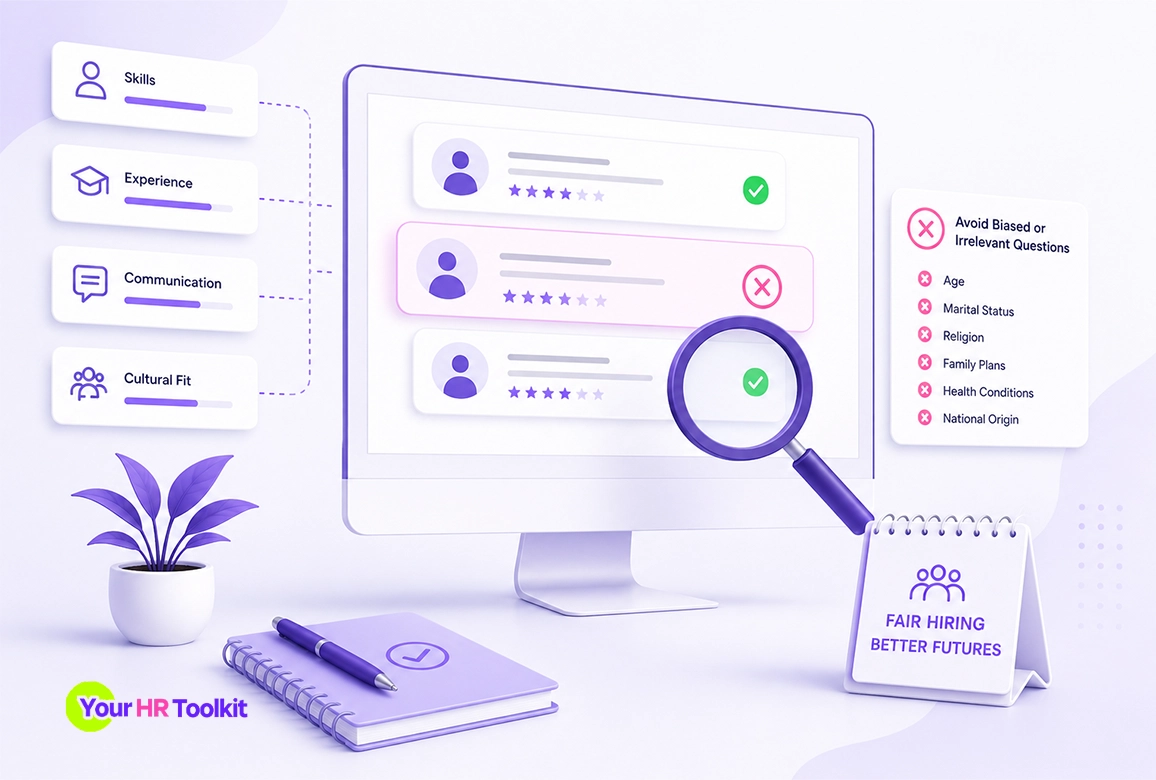
Most hiring managers do not intend to discriminate. But every year in Australia, employers ask interview questions that cross a legal line, not because they are trying to be unfair, but because they simply did not know the question was off limits.
Asking the wrong question in an interview is not just awkward. It can expose your business to a formal discrimination complaint, a Fair Work investigation, or a claim under state and federal anti-discrimination legislation. The consequences are real, and they can be expensive and time-consuming to resolve.
This guide covers which interview questions are illegal in Australia, why they are problematic, and what you should ask instead. It also explains the logic behind the rules so you can apply them confidently in any hiring situation, not just the obvious ones.
Need help building a structured, compliant interview process for your next hire? Try our Recruitment Agent to generate role-specific interview questions from a bank of 120 behavioural questions, formatted into a ready-to-use interview template.
Why Some Interview Questions Are Illegal in Australia
The legal framework around interview questions in Australia is built on anti-discrimination legislation at both the federal and state level. The key federal laws include the Racial Discrimination Act 1975, the Sex Discrimination Act 1984, the Disability Discrimination Act 1992, and the Age Discrimination Act 2004. State and territory laws add additional layers of protection depending on where your business operates.
Together, these laws define a set of protected attributes, personal characteristics that cannot legally be used as the basis for an employment decision. If a question in an interview is designed to reveal information about a protected attribute, or could reasonably lead the interviewer to make a decision based on that attribute, the question is problematic.
The key point is this: employment decisions must be based on merit. A candidate's skills, qualifications, experience, and ability to do the role are the only legitimate criteria. Anything that pulls you toward a decision based on who someone is rather than what they can do is where the legal risk sits.
Protected attributes under Australian law include:
- Race, colour, ethnicity, or national origin
- Age
- Sex and gender identity
- Sexual orientation
- Pregnancy or breastfeeding
- Marital or relationship status
- Family responsibilities or carer status
- Religious or political beliefs
- Disability or medical condition
- Union membership or industrial activity
If a question could reveal information about any of these attributes, you need to either reframe it around the genuine requirements of the role or leave it out entirely.
Interview Questions You Should Never Ask
The following questions are either directly prohibited under anti-discrimination laws or carry a significant legal risk because of what they reveal or imply. They are grouped by protected attribute so you can see the pattern clearly.
Age
Questions to avoid:
- "How old are you?"
- "What year did you finish school?"
- "Are you close to retirement age?"
- "How long do you plan to keep working?"
Age is a protected attribute under the Age Discrimination Act 2004. Asking for a candidate's age, or asking questions designed to infer it, is discriminatory if it influences your hiring decision. Using someone's age as a reason not to hire them, whether they are perceived as too young or too old, is unlawful.
What to ask instead: Focus on the candidate's experience and longevity. "Can you walk me through your relevant experience for this role?" gives you what you need without touching age.
Pregnancy, Family Plans, and Parental Status
Questions to avoid:
- "Are you pregnant or planning to become pregnant?"
- "Do you have young children?"
- "Who looks after your kids when you are at work?"
- "Are you planning to start a family soon?"
- "What does your partner do?"
These questions are among the most common sources of discrimination complaints in Australian workplaces. Pregnancy is explicitly protected under the Sex Discrimination Act 1984, and questions about family plans or childcare arrangements are seen as a proxy for asking about pregnancy or parental responsibilities.
The fact that these questions come up often in interviews does not make them legal. They are asked because interviewers genuinely want to know whether a candidate will be available and reliable. But availability and reliability should be assessed directly, not through questions about someone's personal life.
What to ask instead: "This role requires availability across Monday to Friday between [hours]. Are you able to commit to those hours?" That question is legal, direct, and gets you the information you actually need.
Marital or Relationship Status
Questions to avoid:
- "Are you married?"
- "Do you have a partner?"
- "Are you in a de facto relationship?"
- "What does your spouse think about the travel requirements of this role?"
Marital and relationship status is a protected attribute under Australian law. These questions can also reveal information about gender identity and sexual orientation, which adds an additional layer of legal risk. Unless a candidate volunteers this information themselves, it has no place in an interview.
Religion
Questions to avoid:
- "What religion do you practise?"
- "Do you attend church or a place of worship?"
- "Will your religion affect your availability on weekends or public holidays?"
- "Do you observe any religious holidays we should know about?"
Religious belief is a protected attribute. If your role has genuine availability requirements around certain days or hours, you can ask about those requirements directly without referencing religion at all.
What to ask instead: "This role requires availability on Saturdays. Is that something you are able to commit to?" That question is neutral, fair, and applies equally to every candidate.
Disability and Medical Conditions
Questions to avoid:
- "Do you have any health conditions we should know about?"
- "Have you had any serious illnesses in the past?"
- "Are you on any medication?"
- "Do you have a disability?"
- "How many sick days did you take last year?"
This is an area where many hiring managers genuinely want to be thoughtful but end up asking questions that cross the line. Disability and medical condition are protected attributes under the Disability Discrimination Act 1992. You cannot ask about a candidate's health history, current conditions, or medications.
There is a limited exception: if a specific physical or medical requirement is a genuine, inherent requirement of the role, you can ask whether a candidate can meet that requirement. For example, "This role requires you to regularly lift items weighing up to 20 kilograms. Are you able to do that?" That is a lawful question about capability. "Do you have any back problems?" is not.
What to ask instead: Describe the inherent physical or functional requirements of the role and ask whether the candidate can meet them. Keep the question focused on the task, not the person's health.
Race, Ethnicity, and National Origin
Questions to avoid:
- "Where were you born?"
- "Where are your parents from?"
- "What is your background?"
- "Is English your first language?"
- "Do you have an accent?"
These questions touch on race, ethnicity, and national origin, all of which are protected attributes under the Racial Discrimination Act 1975. They can also veer into territory around cultural background and religion.
If genuine language requirements exist for the role, such as a customer-facing position that requires clear written and verbal communication in English, you can assess that directly through the interview itself or through a skills test, without asking about a candidate's background or heritage.
Sexual Orientation and Gender Identity
Questions to avoid:
- "Are you gay, lesbian, or bisexual?"
- "How do you identify in terms of gender?"
- "Are you in a same-sex relationship?"
- "Have you transitioned or are you considering transitioning?"
Sexual orientation and gender identity are explicitly protected attributes under Australian law. These questions have no bearing on a candidate's ability to do a job and should never appear in an interview.
Union Membership and Political Beliefs
Questions to avoid:
- "Are you a member of a union?"
- "Do you have any issues working in a non-unionised environment?"
- "What are your political views?"
- "Who did you vote for at the last election?"
Union membership and political beliefs are both protected attributes. Asking about union membership in particular is an area where small business owners sometimes stumble, often out of curiosity or concern about industrial relations. Regardless of the intent, the question is off limits.
Criminal History
Questions to avoid in most circumstances:
- "Have you ever been convicted of a crime?"
- "Do you have a criminal record?"
- "Have you ever been arrested?"
This area is more nuanced than the others. In some Australian states and territories, spent convictions (older or less serious offences that have been served) are protected by legislation, meaning employers cannot ask about them or use them in hiring decisions. A conviction that is not spent can be asked about, but only if it is genuinely relevant to the inherent requirements of the role.
If the role involves working with children, handling money, or accessing sensitive personal information, asking about relevant criminal history may be appropriate and required by law. If the role has no such requirements, inquiring about criminal history can expose you to claims of discrimination.
When in doubt on criminal record questions, get HR or legal advice specific to your state before including them in your process.
Try our Recruitment Agent to build a compliant, structured interview process from the ground up. It draws on a bank of 120 behavioural interview questions and formats them into a ready-to-use interview template tailored to your specific role and business.
The Intent Does Not Matter. The Impact Does.
One of the most important things to understand about discrimination law in Australia is that good intentions do not provide a defence. An employer who asks "Are you planning to have children?" might be genuinely trying to understand the candidate's long-term plans for the business. But the question is still discriminatory, and a candidate who was not selected following that question could have grounds for a complaint.
The test is not what you meant. The test is whether the question, or the decision that followed it, was influenced by a protected attribute. That is why it is so important to design your interview process around the role requirements before you sit down with a single candidate.
What Makes an Interview Question Legal
A question is lawful when it is directly and genuinely connected to the requirements of the role. The simplest test is to ask yourself: "Does the answer to this question tell me whether this person can do this job?" If the answer is yes, the question is likely fine. If the answer is "not really, but it would be good to know," take the question out.
Structured, behavioural interviews are the most legally defensible approach to hiring in Australia. Behavioural questions ask candidates to describe how they have handled specific situations in the past, which is both a stronger predictor of future performance and a much safer legal ground than questions about personal attributes.
Examples of strong, compliant behavioural interview questions include:
- "Tell me about a time you had to manage a difficult client or customer. What did you do and what was the outcome?"
- "Describe a situation where you had a conflict with a colleague. How did you approach it?"
- "Give me an example of when you had to meet a tight deadline with limited resources. How did you manage it?"
- "Tell me about a time you made a mistake at work. What happened and what did you learn?"
- "Describe a time when you went beyond what was expected in your role. What drove that?"
These questions reveal capability, character, and judgement without touching any protected attribute. They are the foundation of a defensible, high-quality interview process.
Building a Compliant Interview Process
Knowing which questions to avoid is the first step. The next step is building a process that is structured, consistent, and legally sound every time you hire.
A few practical steps that make a real difference:
- Use the same questions for every candidate. Consistency is your best protection against a discrimination complaint. When every candidate is asked the same questions in the same order, you can demonstrate that the process was fair and merit-based.
- Write your questions before the interview. Do not rely on the conversation to generate questions on the spot. Ad-hoc questions are where the illegal ones slip through. Having a prepared question set keeps you on safe ground.
- Score candidates against the role, not against each other. Use a structured scoring guide tied to the requirements of the position. When your hiring decision is backed by documented scores against defined criteria, it is much harder for a rejected candidate to argue the decision was discriminatory.
- Train anyone who interviews for your business. If managers or team leads are conducting interviews, they need to know what they can and cannot ask. A short briefing before a hiring round can prevent a costly complaint later.
- Document the process. Keep notes from each interview and the rationale for your final decision. If a complaint is ever made, your documentation is your evidence that the process was fair.
Final Thoughts
The rules around illegal interview questions in Australia are not complicated once you understand the principle behind them: hiring decisions must be based on merit, not on who someone is. Any question that could reveal or be influenced by a protected personal attribute is a question that does not belong in your interview.
The good news is that compliant interviewing is also better interviewing. Structured, behavioural questions give you far more useful information about a candidate than personal questions ever could. When you focus on what someone has done and how they have done it, you make better hiring decisions and build a more defensible process at the same time.
If you are building or rebuilding your recruitment process and want to make sure your interviews are legally sound and high quality, try our Recruitment Agent to get role-specific, behavioural interview questions built and formatted for you in minutes.