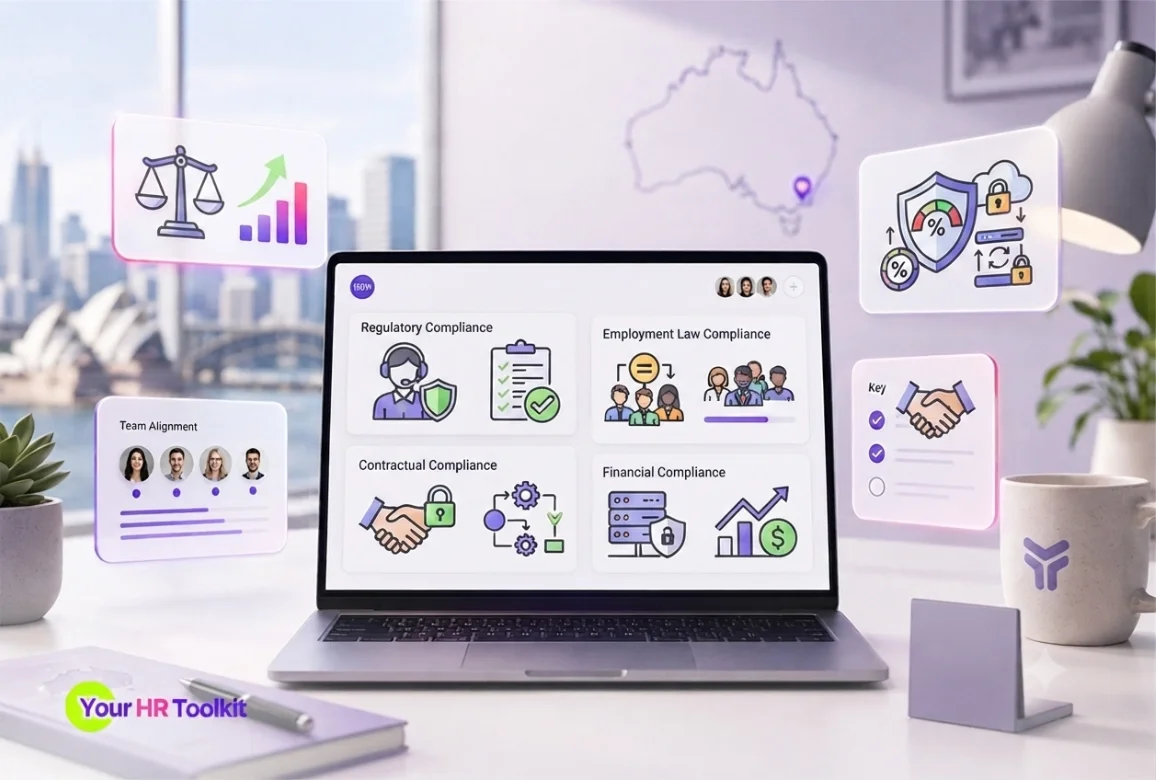
Every Australian business that employs people carries a set of legal, contractual, and regulatory obligations. Most business owners understand this at a surface level. Fewer have a clear system for managing it.
Business compliance is not just about avoiding penalties, though that matters. It is about creating a workplace that is transparent, fair, and legally protected from the inside out. When compliance is handled well, it becomes an operational safety net. When it is ignored, the exposure is significant: Fair Work penalties, workplace injury claims, discrimination complaints, and privacy breaches can all trace back to gaps in compliance management.
An HR toolkit built on AI automates and manages core compliance obligations across the employee lifecycle. It acts as the operational backbone that keeps your business protected while you focus on running it.
In this blog, we will cover the main types of compliance in business, why Australian companies need a clear compliance framework, and how AI is making it easier to stay on top of it all.
What Is Compliance in Business?
Compliance in business means meeting the legal, regulatory, and internal obligations that govern how your organisation operates. In the employment context, this includes following the laws that protect workers, managing the documentation that proves you have done so, and maintaining the policies that set clear expectations for everyone in the business.
In Australia, business compliance is shaped by a combination of federal and state legislation. The Fair Work Act 2009, the Work Health and Safety Act, the Privacy Act 1988, and anti-discrimination laws at both federal and state level all set specific obligations for employers. These are not optional. They apply to every business, regardless of size or industry.
The practical challenge for small and medium businesses is that compliance spans multiple areas at the same time. Employment law, workplace safety, anti-discrimination, privacy, grievance handling, and documentation all need to be managed concurrently, without a compliance team.
That is where AI-powered HR tools change the equation.
Why Australian Companies Need a Business Compliance Framework
A compliance framework is not a filing cabinet full of policies. It is a live system that ensures your business consistently meets its obligations and can demonstrate that it has done so if ever required to.
The Importance of Business Compliance
The consequences of non-compliance in Australia are real and costly. The Fair Work Ombudsman has the power to investigate, audit, and prosecute employers who breach workplace laws. Penalties for underpayment alone can run into tens of thousands of dollars per contravention. Work health and safety breaches carry even higher exposure, with penalties under WHS legislation reaching hundreds of thousands of dollars for serious failures.
Beyond financial penalties, non-compliance damages trust. Employees who experience discrimination, privacy breaches, or poorly handled grievances are unlikely to stay and unlikely to stay quiet. The reputational cost of a publicised compliance failure can outlast the legal penalty by years.
In a tight labour market where every hire is expensive and every resignation is a cost, creating a compliant, fair, and well-documented workplace is also a retention strategy.
Benefits of Compliance in Business
When compliance is managed properly, the benefits go well beyond risk avoidance.
- Protected business. Clear policies, accurate records, and documented processes mean that if a dispute arises, you have evidence. This protects you in Fair Work proceedings, discrimination complaints, WHS investigations, and unfair dismissal claims.
- Clearer expectations. A compliant business has documented standards for behaviour, performance, and conduct. When expectations are clear and consistently applied, there are fewer misunderstandings and conflicts.
- Stronger culture. Businesses that take compliance seriously, particularly around anti-discrimination and grievance handling, signal to their team that fairness is not just a policy. It is how things are done here.
- Reduced management burden. When HR processes and compliance workflows are documented and automated, managers spend less time firefighting and more time leading.
- Better hiring and retention. Candidates and employees choose businesses where they feel safe, respected, and fairly treated. Compliance is a foundation of that experience.
Types of Compliance in Business
Your HR Toolkit supports Australian businesses across six core types of business compliance, delivered through its Policies and Compliance Agent. Each one carries distinct legal obligations and practical requirements.
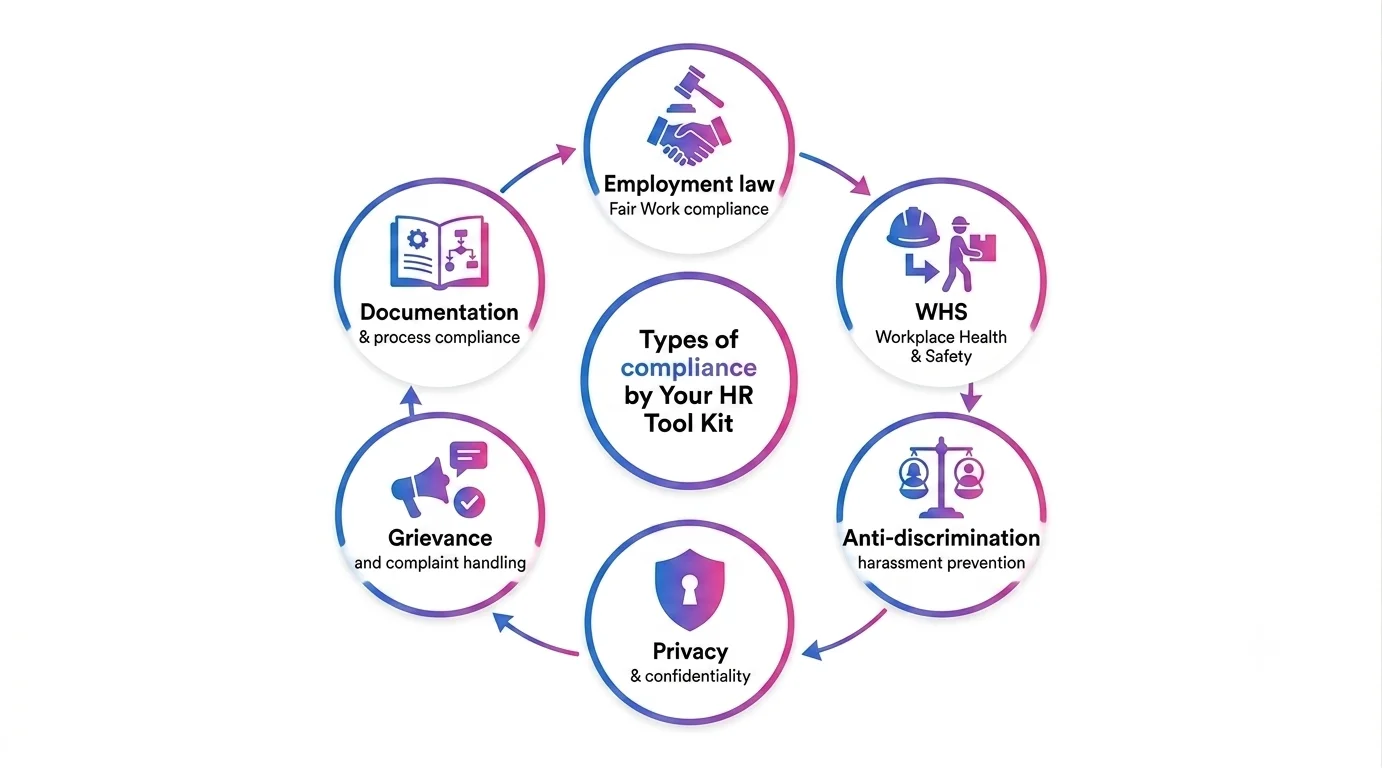
Employment Law and Fair Work Compliance
Fair Work compliance is the most immediate compliance obligation for any Australian employer. The Fair Work Act 2009 sets the legal baseline for every employment relationship in the country through the National Employment Standards, modern awards, and general protections provisions.
Fair Work compliance covers minimum pay rates and how they are calculated under the relevant modern award, leave entitlements for annual leave, personal leave, parental leave, and family and domestic violence leave, superannuation obligations and the upcoming move to payday super from July 2026, record keeping requirements including payslips and employment records retained for seven years, and the correct information statements to issue at the start of employment.
Getting this wrong, even accidentally, can result in back pay orders, civil penalties, and reputational damage. The HR Fundamentals Agent and Policies and Compliance Agent in YourHRToolKit help Australian businesses understand their Fair Work obligations in plain English and generate the documentation needed to meet them.
Workplace Health and Safety (WHS)
Work health and safety legislation in Australia places a primary duty of care on employers to ensure the health, safety, and welfare of their workers, as far as is reasonably practicable. This obligation applies in the office, on the road, at client sites, and in home-based work environments.
WHS compliance requires employers to identify and assess workplace hazards, implement control measures to eliminate or minimise risks, provide appropriate training, equipment, and supervision, maintain records of incidents and near misses, and consult with workers on health and safety matters.
In 2024 and 2025, psychosocial hazards, risks to mental health arising from the design, management, or environment of work, became a sharper compliance focus across Australian states and territories. Employers are now expected to actively manage risks like excessive workload, poor support, and bullying as part of their WHS obligations, not just physical hazards.
Anti-Discrimination and Harassment Prevention
Australian employers are required to provide a workplace free from discrimination, harassment, and victimisation under multiple pieces of federal and state legislation including the Racial Discrimination Act 1975, the Sex Discrimination Act 1984, and the Disability Discrimination Act 1992.
Protected attributes include race, age, sex and gender identity, sexual orientation, pregnancy, disability, religion, marital status, family responsibilities, and union membership. These protections apply across every stage of employment, from recruitment and selection through to performance management and termination.
Anti-discrimination compliance requires more than a policy document. It requires training, consistent management behaviour, a clear complaint process, and a demonstrated willingness to investigate and act when issues arise. This starts at the hiring stage, where even illegal interview questions can expose a business to a discrimination claim before an employment relationship has even begun. The Equal Employment Opportunity and Anti-Discrimination Policy template in YourHRToolKit gives Australian businesses a compliant, practical starting point.
Privacy and Confidentiality
Privacy compliance in Australia is governed by the Privacy Act 1988 and the Australian Privacy Principles (APPs). Every business that collects, holds, uses, or discloses personal information has obligations under this framework.
In the employment context, this covers the collection of employee personal information including health details, tax file numbers, and payment information, secure storage and access controls, limitations on how employee information can be used and shared, and notification and response procedures in the event of a data breach.
A Confidentiality and Privacy Policy is one of the foundational documents every Australian employer should have in place. It sets clear expectations for staff around handling sensitive information and creates a documented standard that can be referenced if a breach occurs.
Grievance and Complaint Handling
Having a clear, fair, and documented grievance process is both a legal and cultural compliance requirement. Employees who feel they have been treated unfairly, experienced discrimination, or have a workplace concern have the right to raise it. How a business responds to that complaint matters legally and culturally.
A compliant grievance process provides an accessible way for employees to raise concerns without fear of victimisation, a clear path from informal resolution through to formal investigation where needed, confidentiality protections for all parties during the process, documented outcomes and any actions taken, and a process that applies consistently regardless of who raises the complaint.
Your HR Tool Kit includes a Grievance and Compliance Policy template that covers each of these elements and can be adapted to the size and structure of any Australian business, supported by practical guidance for leaders on handling these conversations well. The Whistleblower Policy template provides additional protection for employees who need to report serious misconduct or unlawful activity.
Documentation and Process Compliance
Documentation compliance is the connective tissue that holds everything else together. Having the right policies is not enough if there is no evidence they were communicated, acknowledged, or applied.
Employment documentation compliance includes signed employment contracts that reflect the correct award and classification, position descriptions that accurately describe the role, Fair Work Information Statements issued on or before day one, signed policy acknowledgements, records of disciplinary conversations and performance processes, and payroll records and payslips that meet the Fair Work record-keeping standards.
Process compliance means doing things consistently and in the right order. Onboarding processes that skip steps, performance conversations that are not documented, and compliance reviews that only happen reactively are all risk points. When documentation and processes are standardised and supported by AI automation, consistency improves and the risk of gaps reduces significantly.
Why HR Operations Need an AI Compliance Agent
Managing six types of business compliance at the same time, while also running a business, is not realistic without the right tools. An AI compliance agent changes the equation.
Where traditional HR software provides static templates, an AI compliance agent provides contextual guidance. It can explain which modern award applies to a specific role. It can generate a compliant policy document in minutes. It can flag when a process step has been missed. It can coach a manager through the correct way to handle a grievance before they make a decision that creates legal exposure.
The value of an AI compliance agent is not just speed. It is accuracy and confidence. When a business owner or manager can ask a compliance question and get a specific, plain-English answer grounded in Australian employment law, they make better decisions. They catch issues earlier. And they are less likely to rely on guesswork under pressure.
For HR operations in particular, an AI compliance agent reduces the volume of ad-hoc compliance queries that land on HR, freeing up time for more complex and strategic work. It also creates a consistent compliance experience across the business, regardless of which manager is handling a situation. See how this compares across the market in our roundup of the best HR AI agents for Australian businesses.
Your HR Toolkit: Your Ultimate Choice for AI Business Compliance
Your HR Tool Kit is an AI-powered HR platform built for Australian businesses. Its Policies and Compliance Agent is specifically designed to help business owners and managers understand and meet their compliance obligations without needing a compliance specialist on staff.
It covers Fair Work compliance including NES obligations, modern award guidance, and record-keeping requirements. It generates compliant workplace policies across anti-discrimination, privacy, grievance handling, WHS, and more. It guides managers through the correct process for handling complaints, managing performance, and documenting decisions. And it flags compliance risks before they become costly problems.
Every output is grounded in Australian employment law and HR best practice. The guidance is practical, plain-English, and specific to the situation at hand, not generic advice that requires interpretation before it can be used.
For Australian businesses that want to manage compliance confidently without a full HR team, Your HR Tool Kit is the practical starting point. Explore the full range of AI HR agents at yourhrtoolkit.ai, browse more guides on the articles hub, or review pricing to find the right plan for your business.