Underperformance is one of the most common and most avoided management challenges in Australian workplaces. Most managers know something is wrong. Very few have a clear, documented process for addressing it.
A Performance Improvement Plan gives you both. It creates a structured, fair, and documented path for helping an employee meet the standard required in their role. When it is done well, a PIP protects the business, gives the employee a genuine opportunity to turn things around, and keeps the process defensible if it escalates.
The Managing Underperformance Agent on YourHRToolKit helps Australian employers build PIPs, draft supporting documentation, and navigate the formal performance management process with confidence. Or explore the full agent library to see what else is available.
This guide covers everything you need to know: when to use a PIP, how to write one, a free template, real examples, and the most common mistakes to avoid.
What Is a Performance Improvement Plan (PIP)?
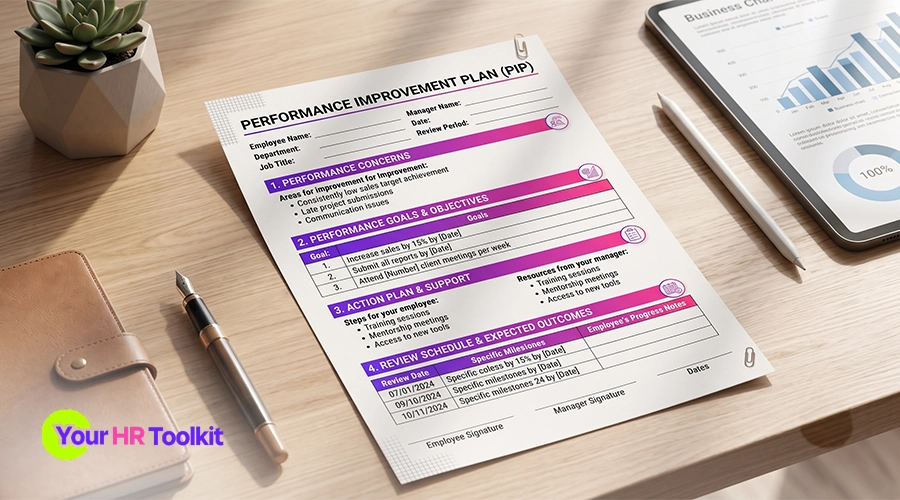
A Performance Improvement Plan is a formal HR document that sets out the specific performance concerns with an employee, the standard they are expected to reach, the support the business will provide, a clear timeline for improvement, and the consequences if improvement does not happen.
A PIP is not a punishment document. It is a structured support tool. Its purpose is to give an employee a clear picture of where they are falling short, what good performance looks like, and what help is available to get them there.
Used correctly, a PIP benefits both parties. The employee gets clarity and a real opportunity to improve. The employer creates a documented record that the issue was addressed fairly, which matters significantly if the situation eventually leads to termination.
The Managing Underperformance Agent can generate a full PIP document once you provide the relevant context about the role and the performance concerns involved. The HR Fundamentals Agent can help you confirm your obligations before you start the process.
When Should Australian Employers Use a Performance Improvement Plan?
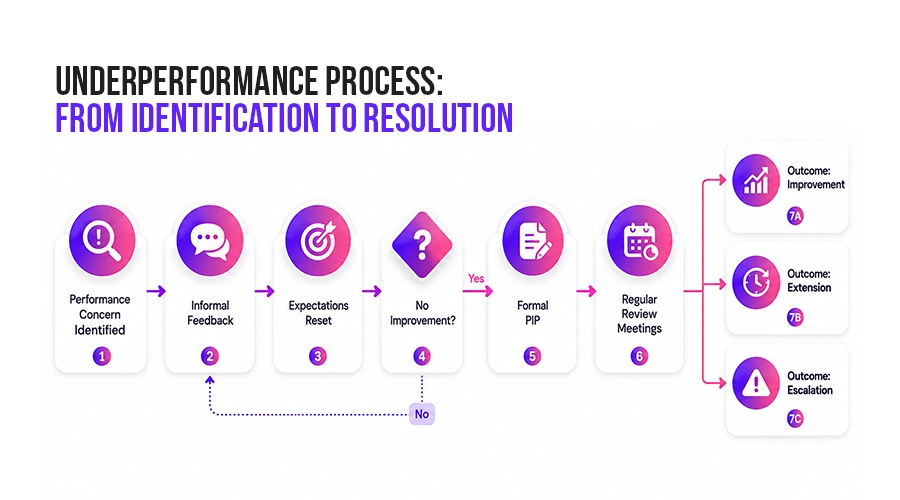
A PIP is a formal tool. It should not be the first response to a performance concern. Before moving to a PIP, most situations should go through an informal conversation, a reset of expectations, and a short monitoring period. If those steps do not produce improvement, or if the concern is serious enough to warrant a structured approach from the start, a PIP is the right next step.
Signs that a PIP may be appropriate include persistent failure to meet KPIs or agreed goals, consistent quality issues despite informal feedback, attendance patterns that are affecting the team or the business, behaviour that does not meet the expected standard after it has been addressed informally, and productivity that is significantly below what the role requires.
Two things to check before you start: first, is the employee still in their probationary period? The approach for employees on probation is different to the formal PIP process. Second, does the employee have clear, documented goals and expectations? If not, a reset of expectations before a PIP is usually the right call.
Understanding your compliance obligations before starting a formal process is important. Read the guides on types of compliance in business and employee entitlements in Australia for more context, or the Policies and Compliance Agent can walk you through the relevant obligations for your specific situation.
Australian Employment Laws and Fair Performance Management
Performance management in Australia is governed by the Fair Work Act 2009. Employees who have completed the minimum employment period (six months for businesses with 15 or more staff, 12 months for smaller businesses) have access to the unfair dismissal provisions of the Act. This means that if their employment is terminated after a PIP process, the process itself will be scrutinised.
The key legal principle is procedural fairness. This means the employee must be clearly told what the performance concern is, given a genuine opportunity to respond, given a reasonable opportunity to improve, provided with support to do so, and made aware of the consequences if improvement does not occur.
A PIP that follows these principles is a legally defensible document. A termination that follows a well-run PIP process, where the employee was given every reasonable opportunity to improve, is significantly less likely to result in a successful unfair dismissal claim.
Employer responsibilities under a fair process include documenting every stage, holding regular check-in meetings during the PIP period, following up meetings with written records, and making genuine efforts to support the employee's improvement.
The Policies and Compliance Agent can help you understand your specific obligations, and the types of compliance in business guide explains the broader compliance framework that sits around performance management.
Common Reasons Employees Are Placed on a PIP
Understanding the nature of the performance concern helps you write a PIP that is specific, fair, and actionable. The most common performance issues that lead to a PIP in Australian workplaces include:
- Low productivity. Output is consistently below what the role requires. Tasks take significantly longer than expected or are incomplete.
- Missed deadlines. The employee is regularly failing to deliver on agreed timeframes despite reminders and informal feedback.
- Poor communication. Failure to keep stakeholders informed, respond to reasonable requests in a timely way, or communicate professionally with colleagues or clients.
- Customer or client complaints. Repeated or serious complaints about the employee's conduct or work quality that have not been resolved through informal feedback.
- Attendance issues. Patterns of unexplained absences, lateness, or failure to follow the correct notification process.
- Lack of accountability. Failing to take ownership of mistakes, deflecting responsibility, or not following through on agreed actions.
- Behaviour concerns. Conduct that is inconsistent with the business's values or workplace standards, particularly after those expectations have already been addressed.
The Managing Underperformance Agent can help you identify which type of concern you are dealing with and guide you to the right documentation for the situation.
Step-by-Step Guide: How to Write a Performance Improvement Plan
Identify the Performance Problem
Be specific. "Not performing well" is not a performance concern. "Has missed four of the last six project deadlines agreed in the monthly goal review" is. Name the specific behaviour, output, or standard that is not being met and when it was observed.
Gather Supporting Evidence
Before putting anything in writing, collect the evidence. This includes missed KPI data, emails, customer complaints, previous feedback conversations, timesheets, or any documented informal discussions. The evidence is what makes the PIP defensible.
Set SMART Goals
Every improvement goal in a PIP must be SMART: Specific, Measurable, Achievable, Relevant, and Time-bound. Vague goals like "improve customer service" are not useful. Clear goals like "achieve a customer satisfaction score of 4.0 or above by 30 June" are. More SMART goal examples are in the section below.
Provide Support and Resources
A PIP must include the support the business is committing to provide. This could be additional training, more frequent check-ins, access to a mentor, clearer process documentation, or shadowing a higher performer. Support is what separates a fair PIP from a paper trail for dismissal.
If you need ideas on structuring regular coaching conversations as part of the PIP, the leadership assessment tools guide and the 1:1 meeting framework are both useful resources. The Everyday Leadership Agent can also generate coaching question sets and meeting agendas for PIP check-in conversations.
Define Review Meetings
The PIP should include a schedule of review meetings throughout the plan period, typically weekly or fortnightly. Each review meeting should be documented. After every meeting, send a brief written summary to the employee confirming what was discussed, where they are tracking, and what the agreed next steps are.
Explain Consequences
The employee must understand what will happen if the improvement goals are not met by the end of the plan period. This is typically escalation to further disciplinary action, which may include termination. Being clear about consequences is not harsh. It is fair. The employee needs to understand the full picture.
Document Everything
Every step of the PIP process should be documented in writing: the initial meeting where the PIP is introduced, each check-in meeting, any changes to the plan, and the final outcome. Follow up every conversation with an email to the employee. If it was not documented, it is very difficult to rely on in a dispute.
Free Performance Improvement Plan (PIP) Template for Australia
Below is a ready-to-use PIP template for Australian employers. Adapt it to your business, the employee's role, and the specific performance concerns you are addressing.
Employee Information
| Field | Detail |
|---|---|
| Employee name | |
| Role title | |
| Department | |
| Manager | |
| Employment start date | |
| PIP start date | |
| PIP end date |
Summary of Performance Concerns
Describe the specific performance issues observed, including examples, dates, and any prior informal feedback that has already been provided.
Example: Over the past eight weeks, [Employee Name] has missed four of six agreed project deadlines. Informal feedback was provided on [date] and [date], but the pattern has continued.
Performance Expectations
Describe clearly what the expected standard looks like for this role and the specific areas where the current performance falls below that standard.
Improvement Goals
| Goal | Target | Measure | Deadline |
|---|---|---|---|
| [Specific goal] | [Target figure or outcome] | [How it will be measured] | [Date] |
| [Specific goal] | [Target figure or outcome] | [How it will be measured] | [Date] |
| [Specific goal] | [Target figure or outcome] | [How it will be measured] | [Date] |
Support and Resources Provided
Detail the support the business is committing to during the PIP period:
- [e.g. Weekly 1:1 check-ins with manager]
- [e.g. Access to [specific training]]
- [e.g. Mentoring from [colleague name/role]]
- [e.g. Updated process documentation for [task]]
Review Schedule
| Review Meeting | Date | Attendees |
|---|---|---|
| Week 2 check-in | ||
| Week 4 check-in | ||
| Mid-point review | ||
| Final review |
Consequences
If the improvement goals are not met by [end date], the business may take further action, which may include [written warning / further disciplinary action / termination of employment]. This decision will be made following a final review meeting.
Signatures
| Party | Name | Signature | Date |
|---|---|---|---|
| Employee | |||
| Manager | |||
| HR / Witness (if applicable) |
Signature confirms the employee has received and understands the PIP. It does not necessarily indicate agreement with its contents.
The Managing Underperformance Agent can generate a fully customised PIP document for your specific situation, including the language and goals relevant to the role and the nature of the performance concern.
Performance Improvement Plan Examples
The following examples show how a PIP might be framed for four common Australian business roles.
Customer Service Representative
- Performance concern: Customer satisfaction scores consistently below the team target of 4.2 out of 5, with three formal customer complaints in the past six weeks.
- PIP goal: Achieve a CSAT score of 4.2 or above for four consecutive weeks by [date].
- Support: Weekly call reviews with team leader, access to customer communication refresher training.
Sales Executive
- Performance concern: Revenue target achieved at 54% of the agreed monthly figure for three consecutive months.
- PIP goal: Achieve 80% of monthly revenue target in month one, 90% in month two, and 100% in month three of the PIP period.
- Support: Weekly pipeline review with sales manager, access to product knowledge training.
HR Officer
- Performance concern: Repeated errors in award classification and payroll documentation, identified in two payroll audits over the past quarter.
- PIP goal: Zero classification errors in monthly payroll run for three consecutive months by [date], confirmed through independent review.
- Support: Training on the Fair Work Award Finder, fortnightly documentation review with HR Manager.
Marketing Coordinator
- Performance concern: Content deadlines missed on 6 of the last 8 deliverables, impacting campaign launch timelines.
- PIP goal: Deliver 100% of agreed content deliverables on or before deadline for the duration of the PIP period.
- Support: Weekly project review with Marketing Manager, use of shared content calendar with milestone dates.
For help customising a PIP for your specific role, the Managing Underperformance Agent can generate role-specific goals and support plans based on the context you provide.
SMART Goals Examples for a PIP
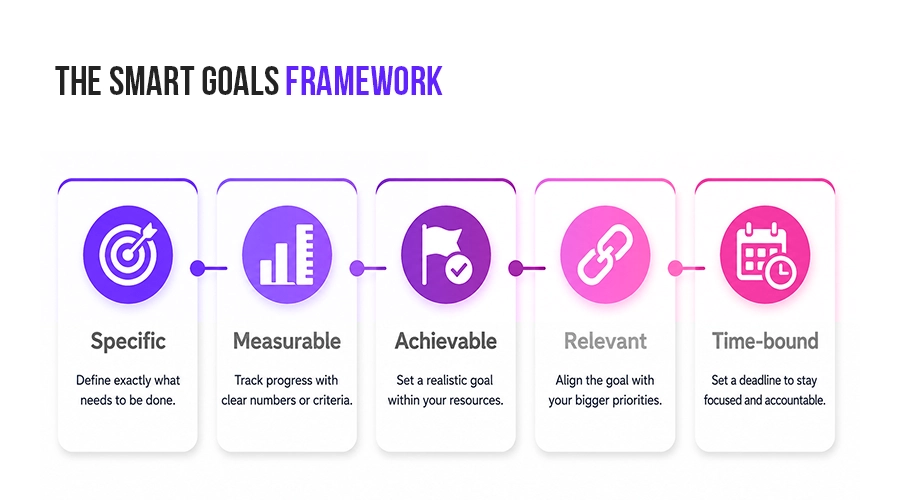
Good PIP goals are SMART. Here are 12 examples across common performance areas. Adapt the targets to fit the role and the standard required.
- Achieve a customer satisfaction score of 4.2 or above for four consecutive weeks by [date].
- Complete all assigned tasks by the agreed deadline with zero escalations for the duration of the PIP period.
- Reduce error rate in [task] from [current rate] to [target rate] by [date], verified through weekly quality checks.
- Respond to all internal and client communications within the agreed response time of 24 hours for the full PIP period.
- Attend work punctually (within 5 minutes of shift start) for all scheduled shifts during the PIP period.
- Submit weekly progress reports by every Friday at 5pm for the duration of the PIP.
- Achieve monthly sales target of [figure] for two consecutive months by [date].
- Complete [specific training module] by [date] and demonstrate application in [task] within two weeks of completion.
- Receive no further customer complaints attributable to [employee's] conduct for the 60-day PIP period.
- Process [task] with a 98% accuracy rate for three consecutive weeks by [date].
- Participate constructively in all team meetings during the PIP period, as assessed by manager at fortnightly check-in.
- Reduce average handling time on [task] from [current time] to [target time] by [date].
For goal-setting frameworks that connect to broader performance management, read the OKR examples guide for Australian businesses.
How Long Should a Performance Improvement Plan Last?
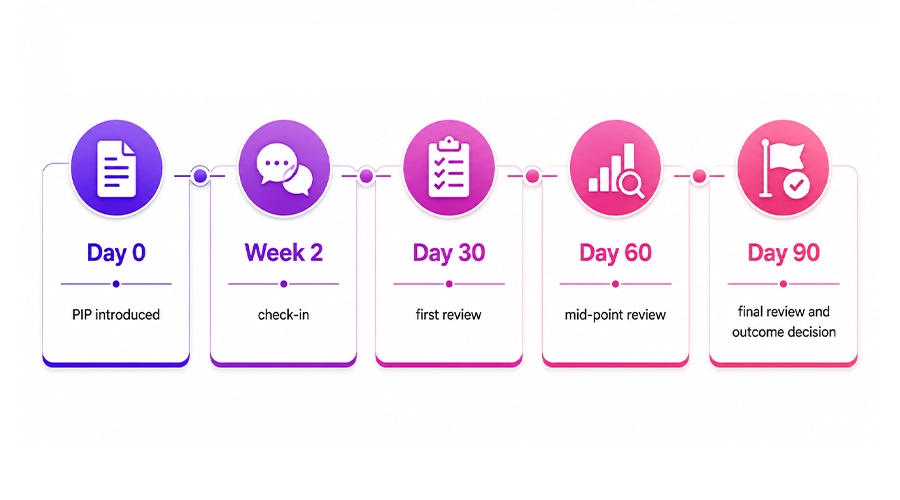
The right PIP duration depends on the nature and severity of the performance concern.
30 days is appropriate for straightforward, measurable concerns where improvement should be visible quickly. Examples include attendance issues, missed deadlines on short-cycle tasks, or specific quality issues that are within the employee's immediate control.
60 days suits most performance concerns where the employee needs time to develop a skill, adjust habits, or demonstrate consistent improvement across a number of weeks. This is the most common PIP duration for Australian employers.
90 days is used for more complex performance concerns, particularly those involving capability development, learning a new system or process, or rebuilding trust after a significant performance gap.
At the end of any PIP period, there are three possible outcomes: the plan is closed because improvement has been achieved, the plan is extended because the employee is showing genuine progress but has not yet reached the target, or the matter escalates to further disciplinary action because improvement has not occurred.
Follow-up reviews every two to four weeks throughout the PIP period are essential. They create the documented record of how the employee tracked and what support was provided, which is what matters if the situation is ever reviewed externally.
Mistakes Employers Should Avoid
- No documentation. The most common and most costly mistake. If a performance conversation was not followed up in writing, it is very difficult to rely on it later. Document everything, every time.
- Unrealistic expectations. Goals that are impossible to achieve in the timeframe given are not fair. They also do not hold up under scrutiny. SMART goals that reflect what the role genuinely requires are the standard.
- No coaching or support. A PIP that sets goals without offering support is not a fair process. The business must provide genuine, practical support as part of the plan.
- No follow-up between reviews. A review meeting every four weeks with nothing in between is not enough. Regular check-ins give the employee feedback in real time and give you early warning if the improvement is not tracking.
- Poor communication. If the employee does not understand why they are on a PIP, what is expected of them, or what the consequences are, the process is not fair. Clarity at every stage matters.
- Treating the PIP as a guaranteed path to dismissal. A PIP should be a genuine attempt to support improvement. If a manager enters the process with the decision already made, that is reflected in how the process is run, and it creates significant legal risk.
If you want to strengthen your leadership and feedback skills alongside managing performance, the leadership assessment tools guide and the 1:1 meeting framework are useful references.
How AI Can Help Manage Employee Performance
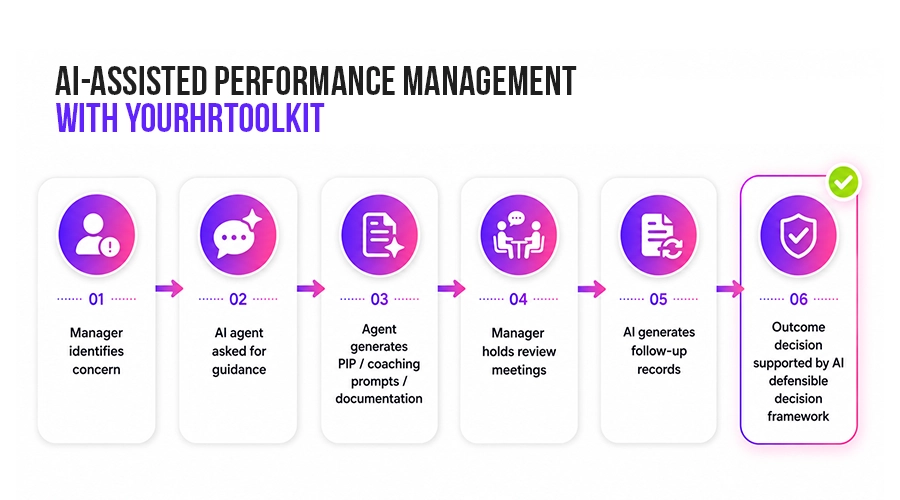
Managing underperformance well requires the right documentation at the right time, consistent coaching conversations, and a clear process that is legally defensible from start to finish. AI makes each of these significantly easier.
The Managing Underperformance Agent on YourHRToolKit can assess your situation and identify whether you are ready to move to a formal PIP or whether informal steps should come first. It generates PIP documents with role-specific goals and support plans. It drafts records of discussion for meetings, written warning letters where appropriate, and messaging guides for show cause meetings. And it guides you through the risk assessment that should happen before any termination decision is made.
It also encourages you to think about General Protections risk, which is a critical consideration in any formal performance process. If an employee has recently made a complaint, taken leave, or exercised a workplace right, terminating their employment after a PIP may carry additional legal risk even if the process was otherwise fair.
For more on how AI is transforming HR and performance management in Australia, read the guides on best AI tools for HR, the best AI HR platform in Australia, and the best HR AI agents for Australian businesses.
Why Australian Businesses Use YourHRToolKit
YourHRToolKit is an AI-powered HR platform built for Australian businesses. The Managing Underperformance Agent is one of nine specialist agents on the platform, each covering a different stage of the employee lifecycle.
For performance management specifically, the platform helps employers document concerns and conversations from the first informal discussion through to a formal PIP and any subsequent steps. It generates the right document for the right stage of the process, keeps the language consistent with Australian employment law, and flags the risks that should be considered before each decision is made.
Business owners and managers who use YourHRToolKit spend less time wondering whether they are doing the process correctly and more time actually managing the situation. That is the difference between a platform that gives you templates and one that gives you guidance.
Conclusion
A Performance Improvement Plan is one of the most important HR tools available to Australian employers. Done well, it gives an underperforming employee a genuine path to improvement and gives the business a legally defensible process if it does not work out.
The key ingredients are always the same: specific goals, genuine support, regular documented check-ins, and clear consequences. Get those right and you have a process that is fair, compliant, and defensible.
If you want to build a PIP for your business today, the Managing Underperformance Agent on YourHRToolKit can generate the documentation you need based on your specific situation. Register here or review pricing to get started.