Most SMEs in Australia manage performance the same way: informally, reactively, and without much documentation. Managers give feedback when something goes wrong. Reviews happen when they have to. And when performance becomes a serious problem, there is no clear process to follow.
This approach is expensive. Low performance that goes unaddressed costs money in lost productivity, team morale, and eventual turnover. And when a business does need to act formally, the absence of a documented performance management process creates significant legal exposure.
A performance management plan changes all of this. It creates a consistent, structured way to set expectations, measure results, give feedback, and address problems early. Done well, it is one of the most effective investments an SME can make in the performance and retention of their team.
If you are already dealing with a formal performance concern, read the guide on Performance Improvement Plan Australia for the specific process and documentation you need.
What Is a Performance Management Plan?
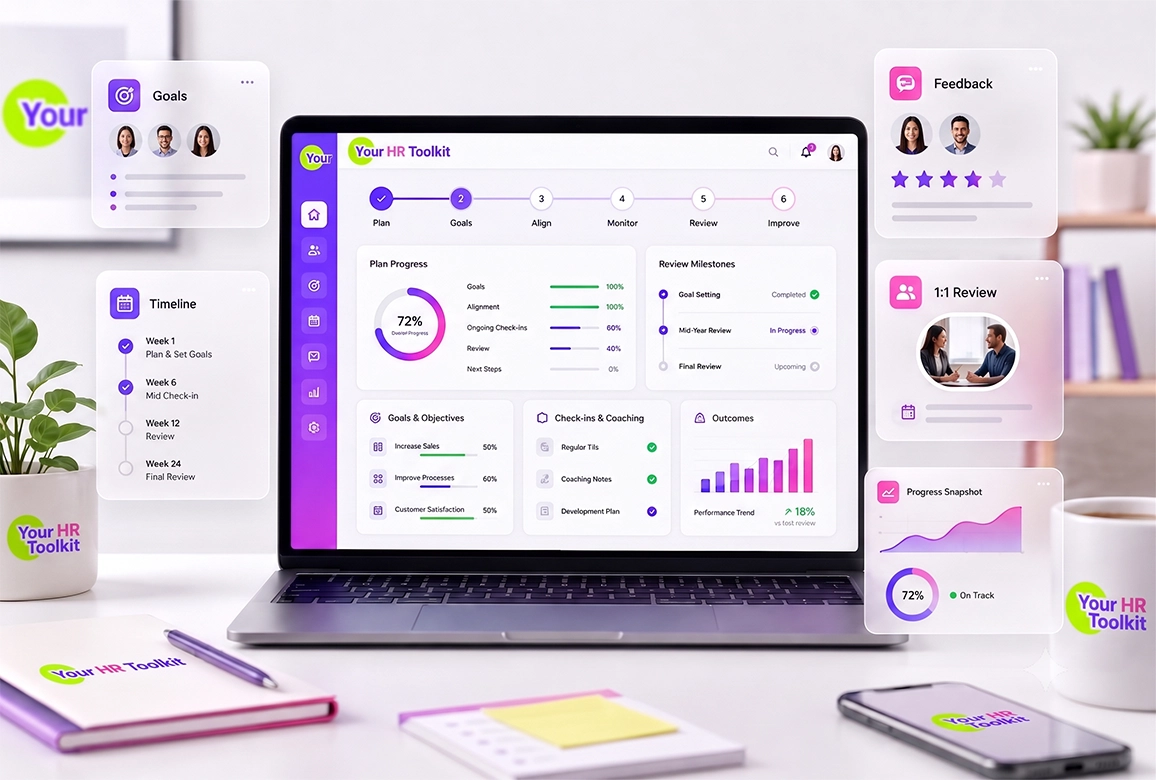
A performance management plan is a structured framework for setting expectations, measuring employee performance, providing ongoing feedback, and supporting both high performers and those who need development. It covers the full cycle of performance, from goal setting at the start of a period through to review, feedback, and development conversations throughout.
A performance management plan is not the same as a Performance Improvement Plan. A PIP is a formal document used when someone's performance has already become a serious concern. A performance management plan is the broader system that ideally prevents that situation from arising in the first place.
The key principles of an effective performance management framework are clarity (employees understand exactly what is expected of them), consistency (the same standards and processes apply across the team), regular feedback (not just at annual review time), and fairness (every employee has access to the same quality of support and development conversation).
For general questions about HR fundamentals and your obligations as an employer, the HR Fundamentals AI Agent at YourHRToolKit can help.
Why Every SME Needs a Performance Management Plan
Without a performance management plan, most SMEs end up managing performance through gut feel and ad-hoc conversations. This creates several problems that compound over time.
Inconsistency. When performance standards are not clearly documented and consistently applied, what counts as good performance varies from manager to manager and team to team. This creates confusion, frustration, and a perception of unfairness.
Missed problems. Underperformance that is not caught early becomes harder and more expensive to address later. A structured plan creates regular checkpoints where concerns can be identified and addressed before they become critical.
Lower engagement. Research from Gallup shows employees with clearly defined goals are 3.6 times more likely to stay committed to their organisation, and team members are 6.7 times more likely to feel engaged when those goals are clear. When people do not know what success looks like in their role, engagement suffers.
Legal exposure. In Australia, employers must follow procedural fairness before taking action on performance issues. A documented performance management process, with records of expectations set, feedback given, and support offered, is the foundation of a legally defensible position. Without it, even fair termination decisions can be challenged.
Retention risk. Employees who do not receive feedback, do not have clear goals, and do not feel their development is being invested in are more likely to leave. Replacing a trained employee costs up to 50% of their annual salary.
A performance management plan that is consistently run and well documented addresses all of these risks simultaneously.
Key Components of an Effective Performance Management Plan
Before getting into the step-by-step process, it helps to understand the five components that every effective performance management plan needs.
Set Clear Business Goals
Performance management starts with business direction. If employees do not understand where the business is going, they cannot connect their own work to that direction. Quarterly business goals, shared with the team, give every individual a line of sight from their daily work to the outcomes the business is trying to achieve.
Define KPIs for Every Role
Key Performance Indicators (KPIs) are the specific, measurable metrics that tell both the manager and the employee whether the role is being performed at the required standard. Every role should have three to five clear KPIs that reflect the core outcomes the position is responsible for. Without these, performance conversations are subjective and difficult to sustain.
Establish Performance Expectations
KPIs tell employees what to achieve. Performance expectations tell them how to achieve it and the standard of behaviour expected along the way. Expectations cover the quality of work, how team members communicate, how they handle challenges, and how they represent the business's values. These should be set in writing, ideally in the position description and reiterated at onboarding and at each goal review.
Schedule Regular Performance Reviews
Annual performance reviews are not enough. Most performance management plans that work well include a formal mid-year and end-of-year review, supported by quarterly goal reviews and fortnightly 1:1 check-ins. This cadence ensures issues are caught early, progress is acknowledged, and goals remain relevant as the business evolves.
Create a Continuous Feedback Culture
Formal reviews matter, but the real performance impact comes from the quality and frequency of informal, ongoing feedback. A culture where managers give specific, timely feedback as a matter of course, and where employees feel safe to raise concerns or ask for help, is the environment where performance management actually changes behaviour.
How to Develop a Performance Management Plan for Your SME (Step-by-Step)
Step 1: Define Company Objectives
Start at the top. What are the two to four most important things the business needs to achieve in the next quarter or year? These become the anchor for everything else. Write them down, share them with the team, and revisit them quarterly.
Business objectives should be specific and directional. "Grow revenue" is not an objective. "Achieve $X in new client revenue by 30 June" is. Clear objectives give employees something concrete to connect their own goals to.
Step 2: Align Employee Goals
Once company objectives are set, cascade them down into individual role-level goals. Each employee's goals should connect clearly to at least one business objective.
Use the OKR framework (Objectives and Key Results) to structure individual goals. The Objective is a clear directional statement of what the person is working toward. The Key Results are three to five specific, measurable outcomes that prove the objective was achieved.
Research consistently supports ambitious, written goals. People who write down their goals are 42% more likely to achieve them. Organisations with clear and ambitious goals can see up to a 90% increase in performance. Time-bound goals with regular progress reviews make people 40% more likely to succeed. These are not soft statistics. For an SME managing a small team, the difference between clear and unclear goals is often visible within a single quarter.
For detailed OKR examples across common Australian business roles, read the OKR examples guide for Australian businesses.
Step 3: Measure Performance
Goals without measurement are wishes. Once goals are set, establish how each key result will be measured and when. This means identifying the specific data source (sales system, quality review, customer satisfaction score), the cadence for tracking (weekly, monthly, quarterly), and who is responsible for reporting.
KPIs should be reviewed in every 1:1 and team meeting. Keeping performance data visible creates shared accountability and removes the end-of-quarter surprise where a manager and employee have completely different views of how things are going.
Step 4: Conduct Regular Reviews
A performance review is not a single annual conversation. The most effective performance review process for SMEs combines:
- Fortnightly 1:1 meetings focused on progress, feedback, and development
- Quarterly goal reviews where targets are assessed, adjusted if needed, and reset for the next quarter
- A mid-year review that assesses the first half of the year and adjusts goals and development plans for the second half
- An end-of-year review that assesses the full year's performance and sets the direction for the year ahead
Each review should be documented. The employee should know in advance what will be discussed and have the opportunity to prepare their own perspective. After the meeting, a brief written summary of what was discussed and any agreed actions should be sent to the employee.
Step 5: Recognise and Reward High Performers
Recognition is one of the most powerful and most underused performance management tools available to SME leaders. Employees who are recognised specifically for contributions that reflect the business's values are more engaged, more loyal, and more likely to repeat the behaviours that earned the recognition.
Recognition does not need to be financial. Specific verbal acknowledgement in a team meeting, a written note that names exactly what the person did and why it mattered, or public acknowledgement of a win are all highly effective. What matters is that it is specific, genuine, and timely.
High performers who are not recognised eventually stop performing at that level or leave. Make recognition a deliberate and regular part of your performance management process.
Step 6: Address Underperformance Early
The most common reason underperformance becomes a serious problem in SMEs is that it is left too long. A manager notices something is off, hopes it will improve, avoids the conversation, and six months later the gap has widened to the point where a formal process is unavoidable.
Early, informal feedback is always the right first response to a performance concern. A direct, specific, and supportive conversation in week two is far easier than a formal process in month six. If informal feedback does not produce improvement, a reset of expectations with clear goals and a short monitoring period is the next step.
If those steps do not work, a formal Performance Improvement Plan is the right next move.
Common Performance Management Mistakes SMEs Make
No documentation. The most widespread and most expensive mistake. Without written records of expectations set, feedback given, and goals agreed, the business has no evidence base for formal action and no protection against an unfair dismissal claim.
Feedback only when something goes wrong. When employees only hear from their manager when there is a problem, feedback becomes associated with negative events. Regular positive, specific feedback creates a feedback culture where development conversations are normal and expected.
Inconsistent standards across managers. Different managers applying different standards to what counts as good performance creates a perception of unfairness. A consistent performance management framework removes this variability.
Annual reviews as the only checkpoint. An annual review can only assess the year in retrospect. By the time a problem is identified in an annual review, it has usually been running for months. Regular quarterly and monthly checkpoints catch issues when they are still manageable.
Setting goals and forgetting about them. Goals set in January that are never reviewed become irrelevant by March. Quarterly goal reviews keep individual goals aligned with what the business actually needs.
Treating underperformance as a personal failing. Most underperformance has a systemic cause: unclear expectations, insufficient training, poor role design, or an unsupportive environment. Before moving to formal action, ask what the business could do differently.
Performance Management Plan Template for SMEs
The following template covers the core components of an individual employee performance management plan. Adapt it to your business, your role, and your review cycle.
PERFORMANCE MANAGEMENT PLAN
Employee Details
| Field | Detail |
|---|---|
| Employee name | |
| Role title | |
| Department | |
| Manager | |
| Review period | |
| Plan created date |
Business Objectives This Period
List the two to four company objectives that this employee's role contributes to.
Individual Goals (OKR Format)
| Objective | Key Results | Target | Deadline |
|---|---|---|---|
| [What are we working toward?] | [How will we prove we got there?] | [Specific measure] | [Date] |
KPIs for This Role
| KPI | Current Baseline | Target | Measurement Method | Review Frequency |
|---|---|---|---|---|
Performance Expectations
Describe the standard of work quality, communication, and conduct expected in this role. Include values-based expectations where relevant.
Development Goals
| Development Area | Action / Activity | Support Provided | Completion Date |
|---|---|---|---|
Review Schedule
| Review Type | Frequency | Next Date |
|---|---|---|
| 1:1 check-in | Fortnightly | |
| Goal review | Quarterly | |
| Mid-year review | 6 monthly | |
| End-of-year review | Annual |
Signatures
| Party | Name | Signature | Date |
|---|---|---|---|
| Employee | |||
| Manager |
How AI Can Improve Performance Management
Performance management involves a lot of documentation, a lot of conversation preparation, and a lot of consistent follow-through. These are exactly the areas where AI HR tools save time and improve quality.
AI can help generate OKR sets and KPIs for specific roles based on the business goals and role description provided. It can prepare managers for performance review conversations with specific talking points, question sets, and development focus areas. It can draft written summaries of review conversations for the employee. It can generate COIN-structured feedback plans for specific situations a manager describes. And it can produce the documentation needed at each stage of a formal performance process.
The YourHRToolKit Pay and Performance Agent handles goal setting, review preparation, and pay outcome documentation. The Everyday Leadership Agent coaches managers through 1:1 conversations, team meeting rhythms, and feedback delivery. Together they cover the full performance management process from goal setting to formal review.
For more on how AI is transforming HR for Australian businesses, read the guides on Best AI Tools for HR, the Best AI HR Platform in Australia, and Best HR AI Agents for Australian Businesses.
Performance Management and Australian HR Compliance
In Australia, performance management is not just a good business practice. It intersects with legal obligations under the Fair Work Act 2009.
Employees who have passed the minimum employment period (six months for businesses with 15 or more staff, 12 months for smaller businesses) have access to unfair dismissal protections. If an employee is dismissed following a performance process, the process itself will be assessed against the standards of procedural fairness and the Small Business Fair Dismissal Code (for businesses with fewer than 15 employees).
This means employers need documentation at every stage: expectations set in writing, feedback provided, formal concerns raised clearly and specifically, support offered, and a genuine opportunity to improve given before any termination decision is made.
Anti-discrimination laws also apply to performance management. Performance reviews and decisions must be based on actual performance against documented standards, not on any protected attribute. Any performance management process that could be perceived as targeting an employee because of a protected characteristic creates legal risk.
For a comprehensive overview of your compliance obligations as an Australian employer, read the guide on Types of Compliance in Business.
Best Practices for Long-Term Employee Performance
A performance management plan is not a one-off document. It is a living system that needs to be maintained, reviewed, and improved over time.
Connect performance to development. The best performance management systems treat development and performance as two sides of the same thing. When employees see that managing their performance well leads to genuine investment in their growth, engagement increases and the quality of performance conversations improves.
Train your managers. A performance management plan is only as good as the managers running it. Managers who lack confidence in giving feedback, running 1:1s, or having difficult conversations will avoid or dilute the process. Investing in manager capability is one of the highest-return investments an SME can make. The leadership assessment tools guide covers how to evaluate and develop leadership capability across your team.
Review and update the framework annually. Goals set for this year may not reflect what the business needs next year. The performance management framework itself should be reviewed annually to ensure the right things are being measured, the review cadence still fits the business, and any lessons from the year are incorporated.
Build psychological safety. Employees who are afraid of feedback will not engage genuinely with a performance management process. Psychological safety, the belief that it is safe to speak up, make mistakes, and ask for help, is the cultural foundation that makes performance conversations productive rather than defensive.
Make recognition specific and frequent. Specific, values-aligned recognition given close to the event is consistently more motivating than generic praise given at an annual review. Build recognition into every team meeting and every 1:1 as a deliberate practice, not an afterthought.
Conclusion
A performance management plan is not a bureaucratic exercise. It is the operational backbone that connects business goals to individual performance, gives employees clarity about what success looks like, and gives managers the structure to have the conversations that actually lift results.
For Australian SMEs, the stakes are real on both sides. Clear performance management drives productivity, engagement, and retention. The absence of it creates legal exposure, management inconsistency, and the kind of slow-burning performance problems that cost far more to fix than to prevent.
Start with the basics: clear goals, defined KPIs, a review cadence, and a commitment to regular feedback. Build from there. And if you need support developing your performance management framework, the YourHRToolKit Pay and Performance Agent and Everyday Leadership Agent give you the tools to do it well. Explore the platform at yourhrtoolkit.ai.